What Is a Synthetic Ice Skating Rink?
Synthetic ice rinks use interlocking polymer panels that let metal-bladed skates glide without refrigeration. Here's how they work, what they cost, and limits.
USA Skating Rinks Editorial Team
Updated July 12, 2026 · Editorial policy
In this guide
Scroll tables sideways to see all columns.
A synthetic ice skating rink is a skating surface built from interlocking panels of solid polymer plastic that allow standard metal-bladed ice skates to glide across it without any refrigeration, water, or electricity. The panels are engineered from polyethylene plastics that have been formulated to reduce friction enough that ordinary hockey and figure skates can carve, stop, and glide much as they would on frozen water.
Unlike a traditional ice rink, a synthetic rink does not melt, does not need a chiller plant, and can be installed indoors or outdoors on any flat, firm surface. The trade-off is more friction underfoot and faster wear on skate blades. The rest of this guide breaks down what the surface actually is, how it performs, where it came from, and who builds it.
What Synthetic Ice Is Made Of
Synthetic ice panels are produced from two related plastics:
- High-density polyethylene (HDPE) — the most common base material, used in mainstream panels for decades.
- Ultra-high-molecular-weight polyethylene (UHMW-PE) — a denser, more abrasion-resistant grade used in higher-end products.
UHMW-PE has the lowest coefficient of friction of the two, and according to product literature its friction is roughly 10–15% greater than that of real ice. Many manufacturers infuse or coat panels with a slip agent that migrates to the surface over time so the panels do not need to be regularly resprayed with a glide enhancer. Xtraice, for example, describes its panels as self-lubricating polyethylene that releases non-toxic lubricant nanoparticles during use.
Older first-generation surfaces (1960s) used polyoxymethylene and required regular silicone treatments; the first full-size HDPE rink, marketed as Hi Den Ice, launched in 1982 and still needed monthly cleaning and respraying. Modern infused polymers have largely eliminated that step.
How the Panels Fit Together
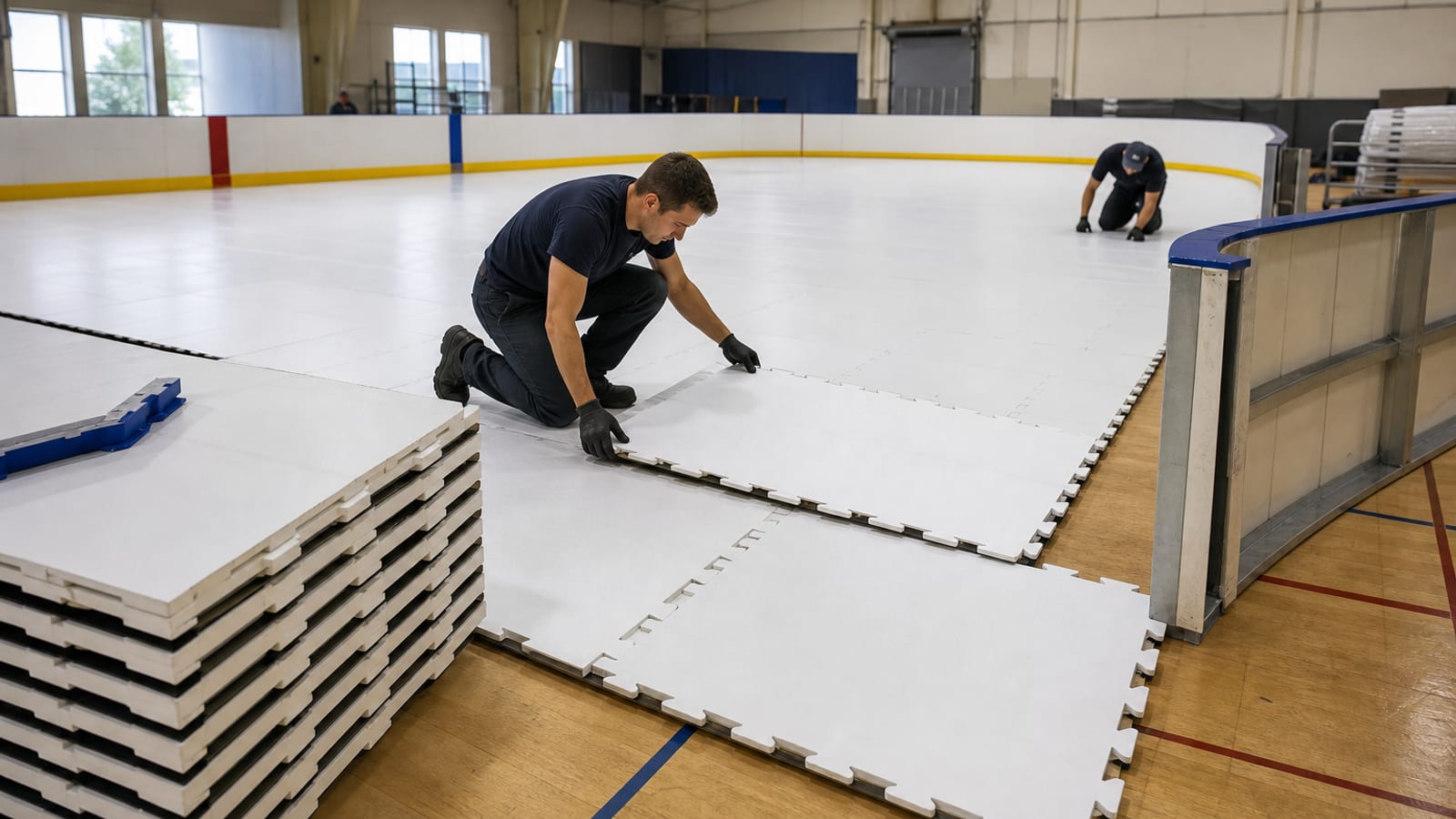
A synthetic rink is assembled like a giant puzzle. Panels are typically supplied in standard building-material sheet sizes and connect with one of two joint systems:
| Joint type | How it works | Substrate needed |
|---|---|---|
| Dovetail / tongue-and-groove | Panels lock edge-to-edge for a seamless surface | Near-perfectly flat subfloor |
| Commercial puzzle joint | Larger interlocks tolerate small imperfections | Most flat surfaces (concrete, asphalt, wood deck) |
Because the panels lock together mechanically rather than bonding chemically, a rink can be expanded, reconfigured, or relocated. Panels can also be cut to fit irregular footprints.
How It Skates Compared to Real Ice
The widely cited industry figure is that synthetic ice delivers about 90% of the glide of refrigerated ice. Xtraice cites a 95% similarity figure for its self-lubricating panels. In practical terms, skaters feel roughly 10–15% more friction, which means:
- More effort is required to maintain speed.
- Crossovers, stops, and edge work all function normally.
- Many coaches view the added resistance as a strength-and-conditioning benefit because it forces deeper engagement of skating muscles.
The most important wear consideration is on the skater, not the surface: blades dull faster on plastic than on water ice. Industry observation puts a sharpening interval anywhere from roughly 30 minutes to a couple of hours of skating, depending on panel material and skater weight.
Where Synthetic Ice Is Used
Common applications include:
- Home training rinks in basements, garages, and backyards.
- Off-season practice surfaces for hockey and figure skating clubs.
- Pop-up holiday rinks in malls, plazas, and resort venues where building a refrigerated sheet is impractical.
- Cruise ships and theme parks, where weight and water are constraints.
- Large public installations — in 2019, Mexico City installed what was reported as the world’s largest synthetic rink, roughly 4,000 m² (about 43,000 sq ft), in the Zócalo.
If you are looking for traditional refrigerated rinks instead, see the main skating rinks directory or browse regional listings such as roller rinks in Pennsylvania.
Major Manufacturers
A handful of companies dominate the North American and global market:
- Glice — Swiss-engineered panels, North American office in Niwot, Colorado; markets a self-lubricating “Ultra Glide” formulation and offers warranties up to 12 years with IIHF certification.
- Xtraice — Founded 2005, headquartered in Seville, Spain; offers Home, Leisure, and Professional product lines, ISO 9001 and ISO 14001 certified, with a 12-year panel warranty.
- KwikRink Synthetic Ice — Founded 1996, based in Minneapolis; known for KwikRink V self-lubricating panels and installations at Mall of America and at NHL outdoor events; 10-year warranty.
- SmartRink — Based in Middle Sackville, Nova Scotia; produces ProFast 1500, 1800, and 5000 panels with a 10-year warranty.
- PolyGlide Ice — California-based; sells Home, Pro, and Commercial panels, with warranties from 3 years on Home panels up to 10 years on Pro and Commercial lines.
Pros and Cons at a Glance
Advantages
- No refrigeration, no water, no electricity to keep the surface frozen.
- Works indoors or outdoors year-round, in any climate.
- Minimal maintenance: regular sweeping and an occasional wipe with mild detergent.
- Modular and relocatable.
Limitations
- Roughly 10–15% more friction than real ice.
- Faster blade dulling and more frequent sharpening.
- Requires a flat, firm subfloor for best results.
- Upfront panel cost can be significant for larger installations.
Frequently Asked Questions
Can you use regular ice skates on synthetic ice?
Yes. Standard hockey and figure skates with sharpened metal blades are what synthetic ice is designed for. No special blade or boot is required, though skaters should expect to sharpen more often.
Does synthetic ice need to be sprayed or treated?
First-generation HDPE panels often required periodic glide-enhancer sprays. Most modern panels from manufacturers like Glice and Xtraice are described as self-lubricating, with slip agents built into the polymer so routine respraying is not required.
What kind of surface do you install it on?
A flat, firm, debris-free subfloor is essential. Concrete, asphalt, finished wood, and level decking are all commonly used. Dovetail joint systems demand a near-perfectly flat base, while commercial puzzle joints tolerate slightly more variation.
Sources
- Synthetic ice — Wikipedia — history, HDPE/UHMW-PE materials, ~90% glide figure, 10–15% friction range, blade-wear interval, Mexico City 2019 installation, joint system descriptions.
- What is Synthetic Ice? — PolyGlide Ice — polymer composition, interlocking panel construction, 10–15% higher coefficient of friction, subfloor and maintenance requirements.
- What is Synthetic Ice? — Xtraice — self-lubricating polyethylene panels, 95% similarity glide claim, company background.
- Synthetic Ice Rink Technology — Glice — self-lubricating tongue-and-groove design, no glide enhancer required.
- Top Synthetic Ice Rink Manufacturers in the US — Sports Venue Calculator — manufacturer founding dates, locations, product lines, warranty terms, and certifications for Glice, KwikRink, SmartRink, PolyGlide, and Xtraice.