Backyard Ice Rink Liners: Sizes, Materials & Buying Tips
Choose a backyard ice rink liner using correct sizing examples, current film and reinforced options, and practical questions about installation and reuse.
USA Skating Rinks Editorial Team
Updated September 20, 2026 · Editorial policy
In this guide
Scroll tables sideways to see all columns.
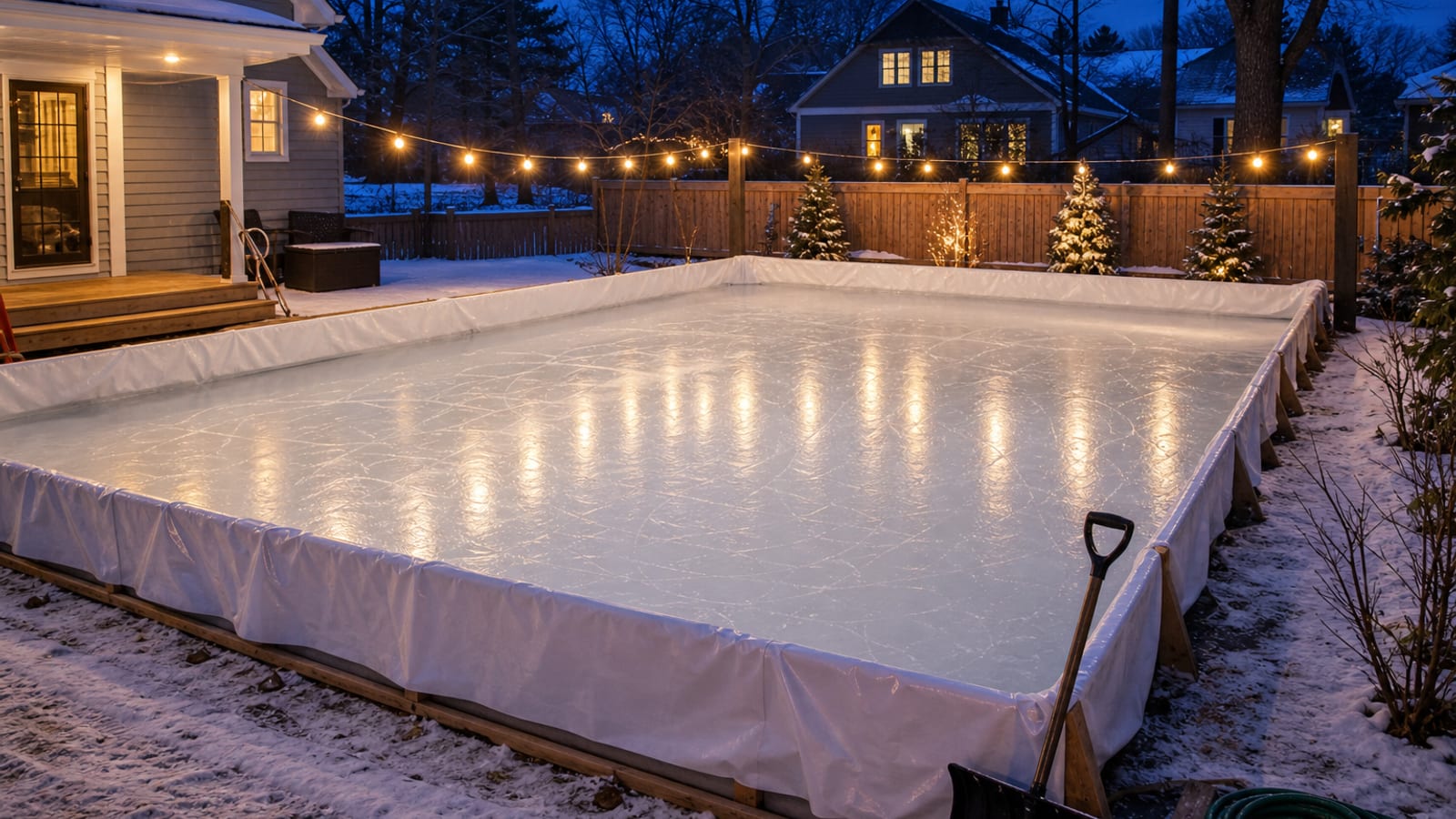
A backyard ice rink liner must cover the ground, climb the boards and leave the supplier’s required allowance outside the frame. Buy by the sheet dimensions and construction, not just the skating area or the largest thickness number.
Specifications below were checked September 20, 2026. Confirm the selected product and dimensions before ordering a cut-to-size sheet.
Film and Reinforced Liners Are Different Products
A mil is 0.001 inch; it is a thickness unit, not a measure of expected lifespan. Reinforcement and layer construction also matter.
| Manufacturer example | Current published description |
|---|---|
| NiceRink NRCS | Three-layer film |
| NiceRink #1 | 6-mil, four-layer reinforced ripstop |
| NiceRink #3 | 10-mil, four-layer reinforced ripstop |
| Iron Sleek standard white liner | 6-mil film |
| Iron Sleek reinforced range | Separate reinforced products, including a 6-mil black/white option |
Sources: NiceRink liner specifications and Iron Sleek liner catalogue.
A reinforced rink liner is not automatically the same product as a general-purpose woven hardware-store tarp. Ask whether the exact material is intended to contain rink water through winter conditions. Avoid choosing solely by color or a “heavy duty” label.
Size the Whole Sheet
Iron Sleek’s selection guide recommends at least 5 additional feet in both overall dimensions, with enough material to extend up and over the boards. Treat that as its starting allowance, not a substitute for measuring tall boards or uneven ground.
The arithmetic for that allowance is:
| Rink footprint | Add 5 feet to each overall dimension |
|---|---|
| 20 × 40 feet | 25 × 45-foot sheet |
| 25 × 45 feet | 30 × 50-foot sheet |
| 30 × 50 feet | 35 × 55-foot sheet |
Adding 5 feet overall is different from adding 5 feet on each side. For example, the latter would turn a 20 × 40-foot footprint into a 30 × 50-foot sheet.
Send the supplier your footprint, ground measurements and board heights. Have it confirm the actual sheet size, extra allowance and available stock widths. If a calculator rounds up to a wider product, retain that final product size when comparing quotes.
Choose Color and Construction Together
Iron Sleek explains that a white surface reflects solar heat and offers both white film and black/white reinforced products. Check the installation orientation for the exact liner you order. A color recommendation is not a guarantee of ice quality or lawn survival. Manufacturer guidance.
Ask these questions before paying:
- What are the finished sheet dimensions and manufacturing tolerances?
- Is this film or reinforced material, and is it intended for a rink?
- Which side faces up?
- What support or preparation is needed beneath it?
- What repair material is compatible?
- What are the shipping charges and return terms for a custom cut?
Installation and Repair
Inspect the frame and ground for sharp objects before laying out the liner. Iron Sleek specifically warns about inward-facing screws and says the sheet must settle into the rink before final attachment. Its liner page describes repair tape, not a universal heat-welding procedure. Installation notes.
Follow your own supplier’s sequence for laying, securing and filling. A full sheet is not something to drag into position after water has been added. Ask about the appropriate repair for a puncture before trying adhesive or heat.
For the wider project, use the home ice rink planning worksheet.
Can You Reuse a Liner?
Do not budget on a guaranteed number of seasons. Iron Sleek allows for reuse but recommends a new liner annually because removal and storage can introduce damage. Reuse guidance.
Before reusing yours, inspect it and ask the manufacturer about cleaning, storage, repairs and any warranty conditions. Include replacement in the budget so a damaged sheet does not derail the next season.
Frequently Asked Questions
Is a 24 × 45-foot liner enough for a 20 × 40-foot rink?
It does not meet an allowance of 5 extra feet in both dimensions: its width adds only 4 feet. The arithmetic gives 25 × 45 feet, and your boards or ground may require more.
Is thicker always better?
Thickness alone cannot compare film and reinforced products. Match the material, dimensions and intended use to the manufacturer’s guidance.
Can I join smaller tarps?
Ask the supplier about an approved watertight system before ordering separate sheets. Do not assume ordinary taped overlaps will meet a rink’s requirements.
Should I buy the liner before measuring the slope?
Measure first. Ground variation changes the water depth and board design, which can change how much material must reach up the sides.