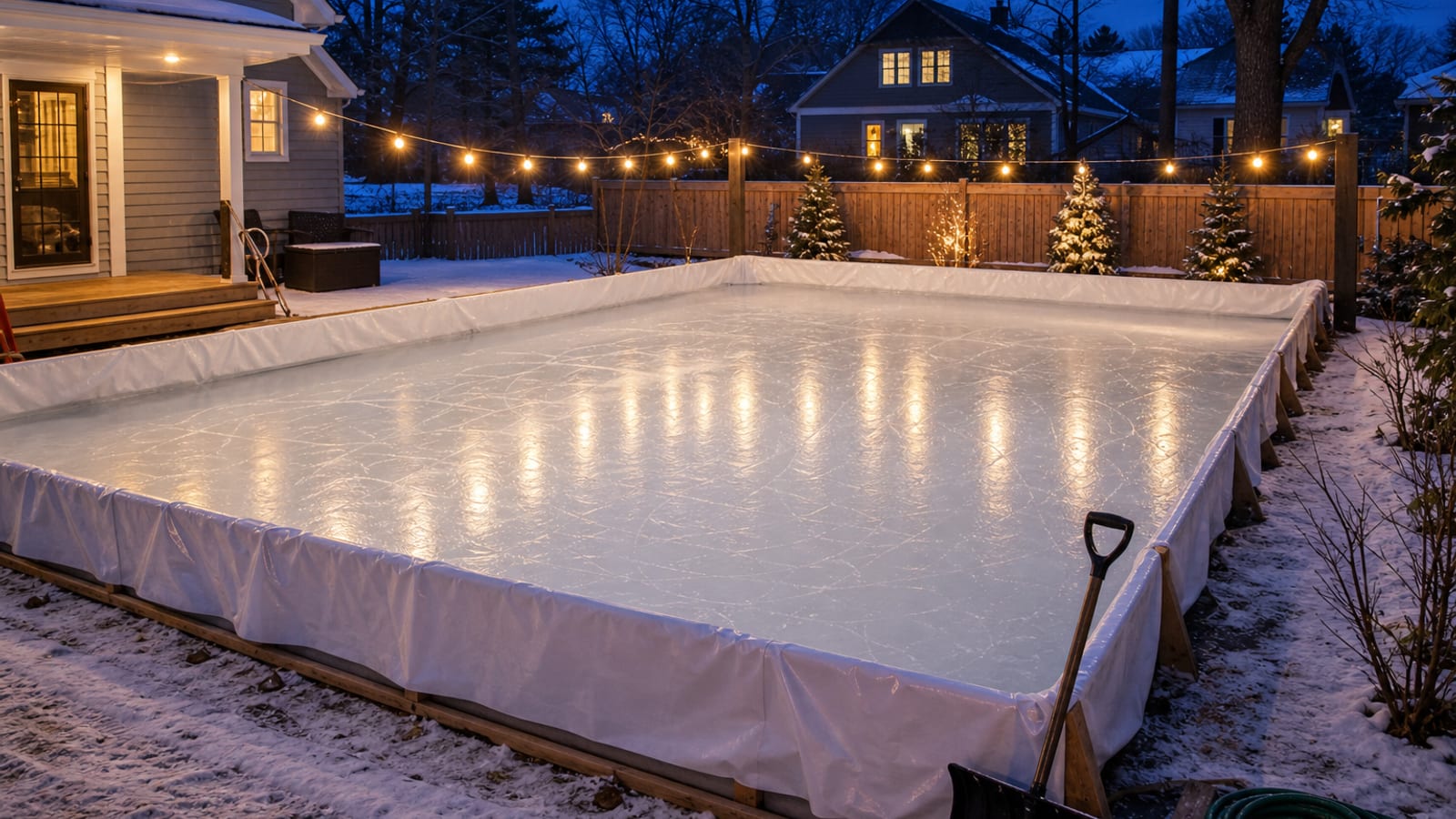
Home Ice Skating Rink: Slope, Water & Budget Guide
Plan a backyard ice rink with a slope worksheet, water-volume example, budget checklist and links to current manufacturer installation guidance.
USA Skating Rinks Editorial Team
Updated September 20, 2026 · Editorial policy
In this guide
Scroll tables sideways to see all columns.
Before buying a home ice skating rink kit, measure the yard’s elevation change, work out the deepest water level and check that the chosen board system supports your design. A kit’s advertised footprint does not establish that it fits your slope, climate or complete budget.
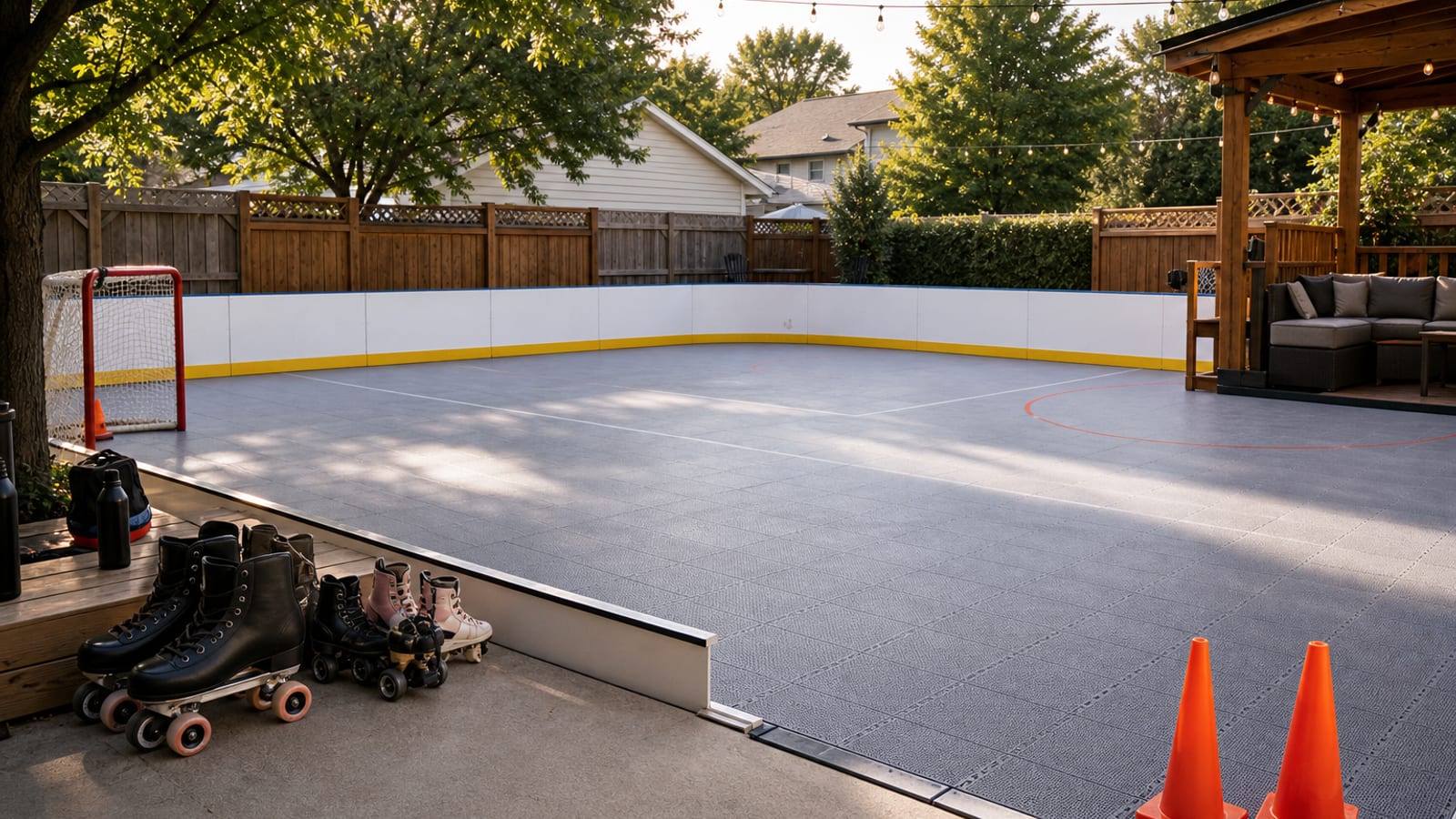
This guide covers a seasonal, ground-supported rink with a liner. Refrigerated systems need their own site design and operating-cost quote. Compare the alternatives in our backyard ice versus roller rink guide.
Measure the Yard Before Ordering
Record the proposed length and width, highest and lowest ground points, water access, drainage route and space around the rink. Measure elevation rather than judging the lawn by eye.
Depth at the lowest ground point = depth at the highest ground point + elevation difference.
For example, if a design specifies 4 inches at the shallow end and the ground drops 8 inches, the deep end would hold 12 inches. This is an illustration of water-level geometry, not a specification for safe ice or adequate bracing.
Send those measurements to the kit supplier. Ask it to confirm the board height, support layout, ground conditions and required clearance above the water before ordering. HockeyShot’s manufacturer-authored planning guide also emphasizes measuring slope before choosing components.
Match the Supports to the Exact System
Board height, bracket spacing and water capacity are different measurements. Do not use the spacing chart from one brand to assemble another.
For example, NiceRink’s installation instructions change the support requirements for deeper water and tell customers to contact the company at 18 inches or more. That is not a universal capacity rating for backyard rink kits.
Keep the instructions for the exact model and configuration you buy. If your measurements fall outside them, obtain a revised design before filling.
Estimate Water Volume
For a rectangular rink:
US gallons ≈ length in feet × width in feet × average water depth in feet × 7.48.
For a hypothetical 20 × 40-foot rink over an evenly sloping base with depths of 4 and 8 inches:
- Average depth: (4 + 8) ÷ 2 = 6 inches, or 0.5 feet.
- Water volume: 20 × 40 × 0.5 × 7.48 = approximately 2,992 US gallons.
That is the initial liquid-water estimate, before leaks or maintenance fills. Averaging only the two endpoints works for a uniform slope; hollows, humps and irregular shapes need a more detailed estimate.
For a budget, multiply the estimated gallons by the utility’s applicable rate. Check whether sewer charges, watering restrictions or delivery fees affect the bill.
Build a Complete Budget
Compare quotes for the same footprint and measured slope. Use these separate lines:
| Budget item | What the quote should clarify |
|---|---|
| Boards and supports | Included materials, corners, extra support and ground attachment |
| Liner | Actual sheet dimensions, material and delivery |
| Site preparation | Any grading, drainage work or obstacle removal |
| Initial fill | Metered water or delivery cost |
| Maintenance | Snow-clearing tools, resurfacing equipment and repairs |
| Accessories | Entry protection, lighting and any hockey equipment |
| Storage and replacement | Off-season space and allowance for damaged components |
| Refrigeration, if selected | Installation, electrical work, energy and servicing |
A low kit price may exclude lumber, shipping or site work. Request an itemized current quote instead of treating an old online price as the cost of a completed rink.
Choose a Liner for Your Measurements
Order the sheet for the rink footprint and the climb up the sides, with the allowance specified by the supplier. Thickness alone does not describe construction: some rink liners are film and others are reinforced.
Our backyard rink liner guide includes corrected sizing examples and a comparison of current manufacturer descriptions.
Plan Filling and Opening Around Conditions
Use the supplier’s installation and filling sequence. Check the upcoming weather and the deepest part of your design before starting; keep a route for managing water during thaw and dismantling.
HockeyShot’s published freezing estimate is explicitly tied to several conditions, including water depth, liner, cooled ground and day/night temperatures. It is not a promise that any rink will be ready within a fixed number of days. Read the conditions.
Do not decide that a surface is ready because a calendar interval has passed or a thin frozen layer appears. Have the supplier explain how to assess the completed rink and when to close it during warming conditions. Advice for a lined backyard rink should not be applied to ponds or lakes.
Frequently Asked Questions
How much does a home ice skating rink cost?
The useful number is an itemized quote for your footprint, slope and system. Add water, delivery, site preparation, maintenance and replacement costs before comparing it with regular trips to a public rink.
Does the yard need to be perfectly level?
Measure the difference first. A slope increases the deep-end water level and can change the equipment required. The supplier needs those measurements to confirm the design.
Will the liner protect the lawn?
Do not assume the lawn is guaranteed to recover unchanged. Ask about timing installation and removal for your local grass and weather, plus a drainage plan for spring.
Can I enlarge the rink later?
Ask which components can be reused and what the larger design needs. Extra area can change the liner size, water volume, support layout and maintenance workload.
Sources and Review
Manufacturer guidance checked September 20, 2026. Links above support the system-specific claims. Water calculations and the quote checklist are our planning examples; they are not structural plans.