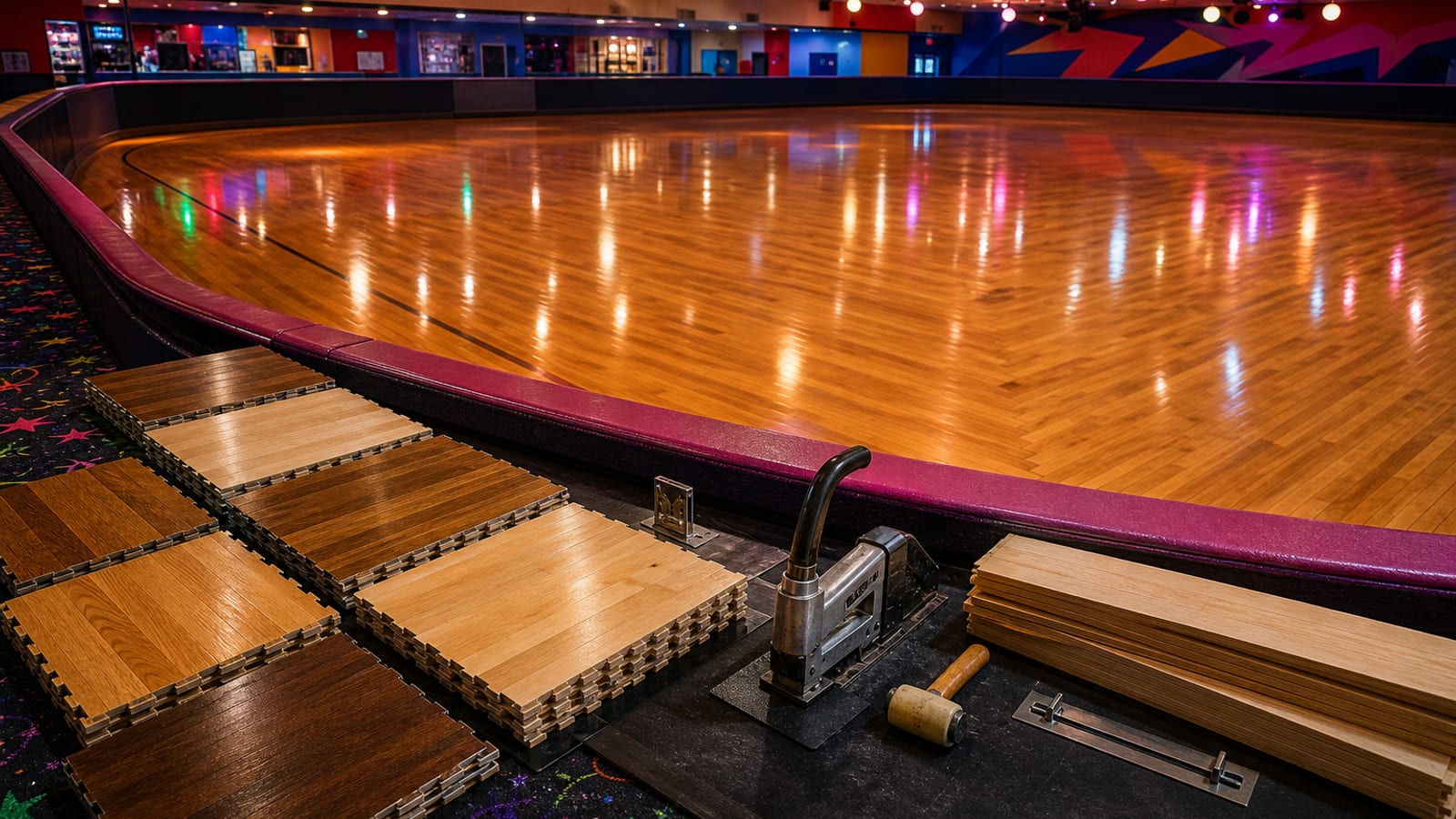
Roller Skating Rink Floor Cost by Surface Type
Compare roller skating rink floor costs by surface: maple wood, coated concrete, synthetic sheet, and modular tile pricing per square foot and per rink.
USA Skating Rinks Editorial Team
Updated July 12, 2026 · Editorial policy
In this guide
Scroll tables sideways to see all columns.
Choosing a rink floor is one of the largest single line items in a roller skating facility budget, and the spread between the cheapest and most expensive surface can be more than ten to one. This guide breaks down typical per-square-foot pricing for the four surfaces commonly used in commercial and community roller rinks — hardwood maple, coated concrete, poured or sheet synthetic, and modular interlocking tile — along with the trade-offs that drive the price differences.
For context, a “standard” commercial roller rink floor is usually somewhere between 10,000 and 15,000 square feet of skating surface, not counting the carpeted apron, snack bar, or skate rental area. Floor pricing scales roughly linearly with that footprint.
What’s Actually Included in a Roller Rink Floor Quote
Still deciding on the surface? Compare roller rink floor types, skating feel, and maintenance before comparing installation quotes.
A floor quote is rarely just the surface material. A complete installed price typically bundles:
- Subfloor preparation (leveling, moisture barrier, sleepers for wood)
- The wear surface itself (planks, tiles, or coating)
- Sanding and sealing, or tile interlock and edge trim
- Striping, logos, and any color zones
- Labor and freight
Quotes that look unusually low often exclude subfloor prep or finishing, so it’s worth confirming scope line by line before comparing bids.
Hardwood Maple: The Premium Standard
Hard maple — typically northern hard maple in tongue-and-groove strip — is the traditional commercial rink surface. It skates softer than concrete, is forgiving in falls, and can be refinished multiple times across a multi-decade lifespan.
Reported pricing for installed maple in a roller rink falls in the range of roughly $6 to $10 per square foot for materials and around $4 to $8 per square foot for professional installation, with total installed cost commonly cited between roughly $10 and $15 per square foot. For a 15,000-square-foot rink, one industry build-cost guide places a hardwood floor at roughly $150,000 to $315,000 all-in.
Maple floors also carry the highest recurring maintenance: budget for periodic screen-and-recoat work and occasional full resands. One published estimate puts ongoing maple floor maintenance in the range of $5,000 to $10,000 per year for a commercial rink.
Coated Concrete: The Workhorse
Polished or coated concrete is the most common surface in newer purpose-built rinks and in converted warehouse spaces. The slab itself is inexpensive — roughly $1 to $2 per square foot in raw materials — but the cost driver is the specialty coating that makes it skateable. Published ranges put high-quality skating coatings at roughly $3 to $6 per square foot installed, putting fully coated concrete somewhere between $3 and $10 per square foot total depending on system thickness and prep.
For a 15,000-square-foot rink, a coated-concrete floor is commonly cited in the range of $90,000 to $315,000 installed, with the high end reflecting premium urethane systems and extensive slab prep.
Concrete is faster to skate, much lower maintenance than maple, and tends to last longer between major refinishes — at the cost of a harder, less forgiving surface for falls.
Sheet and Poured Synthetic Surfaces
Sheet vinyl, PVC, and poured polyurethane synthetics sit between maple and concrete on both price and feel. Reported installed pricing typically runs $2 to $5 per square foot for the material plus $1 to $3 per square foot in labor, with rubber-based systems pushing into the $5 to $12 per square foot range. A 15,000-square-foot synthetic install is commonly cited between $90,000 and $255,000.
These surfaces are popular in multi-use facilities because they’re quieter than concrete, easier on joints, and available in a wide range of colors for branded designs.
Modular Interlocking Tile: The Budget and Pop-Up Option
Interlocking polypropylene tile systems — sold by vendors such as VersaCourt, ModuCourts, and several Asia-based manufacturers — are the lowest-cost option and the only one that’s practical for pop-up rinks, temporary events, or outdoor installations.
Published per-tile and per-square-foot pricing for these systems ranges from roughly $1 to $5 per square foot depending on the tile, with budget commercial tile commonly listed around $1.20 to $3 per square foot from factory-direct suppliers. For a 15,000-square-foot rink, total floor cost typically falls between $15,000 and $45,000, making it by far the cheapest entry point.
The trade-off: tile floors don’t skate quite like a continuous surface, can shift over a poor subfloor, and the wear life is shorter than a properly maintained maple or coated concrete floor.
Side-by-Side Cost Summary
| Surface | Installed cost / sq ft | 15,000 sq ft rink |
|---|---|---|
| Hardwood maple | ~$10–$15 | ~$150,000–$315,000 |
| Coated concrete | ~$3–$10 | ~$90,000–$315,000 |
| Sheet/poured synthetic | ~$3–$8 | ~$90,000–$255,000 |
| Modular tile | ~$1–$5 | ~$15,000–$45,000 |
These ranges are drawn from published industry cost guides; actual quotes vary by region, subfloor condition, and the specific product spec.
How the Floor Fits in the Total Budget
A new roller skating rink is rarely a floor-only project. Industry build estimates commonly place total project cost — including space, fitout, lighting, sound, and rental skates — between roughly $500,000 and $1.5 million for a typical commercial facility, with the floor itself usually 10–25% of that total depending on surface choice.
For a directory of operating rinks across the U.S., see the main skating rinks directory, or browse by state on the Texas roller rinks page for examples of how different facilities have spec’d their surfaces.
FAQ
Is wood or concrete cheaper for a roller rink?
Coated concrete is generally cheaper than hardwood maple, both up front and over time. Raw slab cost is roughly $1–$2 per square foot, and even with a high-end skating coating the total typically lands below comparable installed maple, which commonly runs $10–$15 per square foot installed.
What’s the cheapest way to build a skating surface?
Modular interlocking polypropylene tiles are the lowest-cost option, with published pricing as low as roughly $1–$3 per square foot from factory-direct suppliers and total floor costs around $15,000–$45,000 for a 15,000-square-foot rink. They’re also the standard choice for outdoor or temporary installations.
How long does a roller rink floor last?
With proper maintenance, hardwood maple floors can last decades and be refinished multiple times. Coated concrete systems are typically rated for 10–30 years depending on the coating spec, and most modular tile manufacturers offer warranties in the 10–15 year range.
Sources
- How Much Does A Roller Skating Rink Floor Cost? — OwnersOasis — per-square-foot pricing for maple, synthetic, concrete; maintenance estimates
- How Much Does it Cost to Build a Roller Skating Rink? — ROLLER — total project costs and floor cost ranges by material for a 15,000 sq ft rink
- Wooden Vs. Concrete Roller Rink — Skateworld — comparison of wood vs concrete skating feel, maintenance, and durability
- VersaCourt Skating Rink Flooring — modular polypropylene tile product specs and features
- Roller Skating Floor Specialists — ZSFloor Tech — modular tile factory-direct pricing range