Roller Skating Rink Construction: Build Phases & Timelines
How roller skating rinks get built: site selection, structure, floor systems, and realistic cost ranges and phase timelines from industry sources.
USA Skating Rinks Editorial Team
Updated May 29, 2026 · Editorial policy
In this guide
Scroll tables sideways to see all columns.
Building a roller skating rink is part real estate project, part specialty sports-flooring install, and part family entertainment design. The work touches zoning, structural shell construction, HVAC, a precision skating surface, lighting and sound, and front-of-house finishes. This guide walks through the typical build phases, how long each tends to take, and what industry sources report on cost ranges as of the most recent published guidance.
Most operators land somewhere in a wide band: published estimates for a standard new-build roller skating rink run roughly $2–5 million, while a full family entertainment center (FEC) with a rink as the anchor attraction is reported at $12–18 million. A more modest renovation of an existing structure can come in well below those numbers — closed rinks have been listed for sale at under half of the $1.2M starting point reported in the industry press.
Phase 1: Feasibility, Site Selection, and Permitting
Before any construction begins, the project needs a defensible business case and a site that fits both the floor plan and local code.
A typical skating area runs about 15,000 square feet, often laid out as a roughly 125′ × 125′ space with a rounded oval skating path, though target overall building footprints commonly fall in the 15,000–30,000 sq ft range once you include reception, party rooms, concessions, restrooms, skate rental, and storage. The Roller Skating Association International (RSA) — the industry’s trade group since 1937 — publishes a multi-hundred-page Industry Guide for prospective operators that covers construction guidelines, projected income, operating costs, and business planning.
Feasibility and entitlements typically take 2–6 months, depending on whether the parcel is already zoned for assembly use and how responsive the local building department is.
Phase 2: Structural Shell
Most modern rinks use a pre-engineered metal building (PEMB) because of the clear-span interior it provides — no interior columns interrupting the skating surface. Industry reporting puts a roughly 27,000 sq ft metal building shell at over $500,000, and that figure typically excludes foundation, doors, windows, and installation labor. Building-only construction costs are commonly cited in the $25–$120 per square foot range above the floor system, varying with region, finishes, and code requirements.
Shell construction (foundation, slab, steel, roof, envelope) generally takes 3–6 months for a ground-up project. Retrofits of existing warehouses or retail boxes can be faster but often trigger upgrades to fire suppression, restrooms, and accessibility.
Phase 3: The Skating Floor
The skating surface is the single most important — and most variable — line item in the budget. Published cost ranges for a 15,000 sq ft rink are:
| Floor Type | Reported Range (15,000 sq ft) |
|---|---|
| Hardwood (e.g., northern hard maple) | $150K – $315K |
| Synthetic | $90K – $255K |
| Concrete (sealed/coated) | $90K – $315K |
| Modular plastic tile | $15K – $45K |
Other industry sources put the all-in floor cost anywhere from $75K to $1 million depending on material grade, installer, and shipping. Northern hard maple is widely treated as the traditional benchmark because it balances grip and glide for both quad and inline skates, but it is not strictly required — many newer venues choose synthetic or coated concrete for lower upfront cost and easier maintenance.
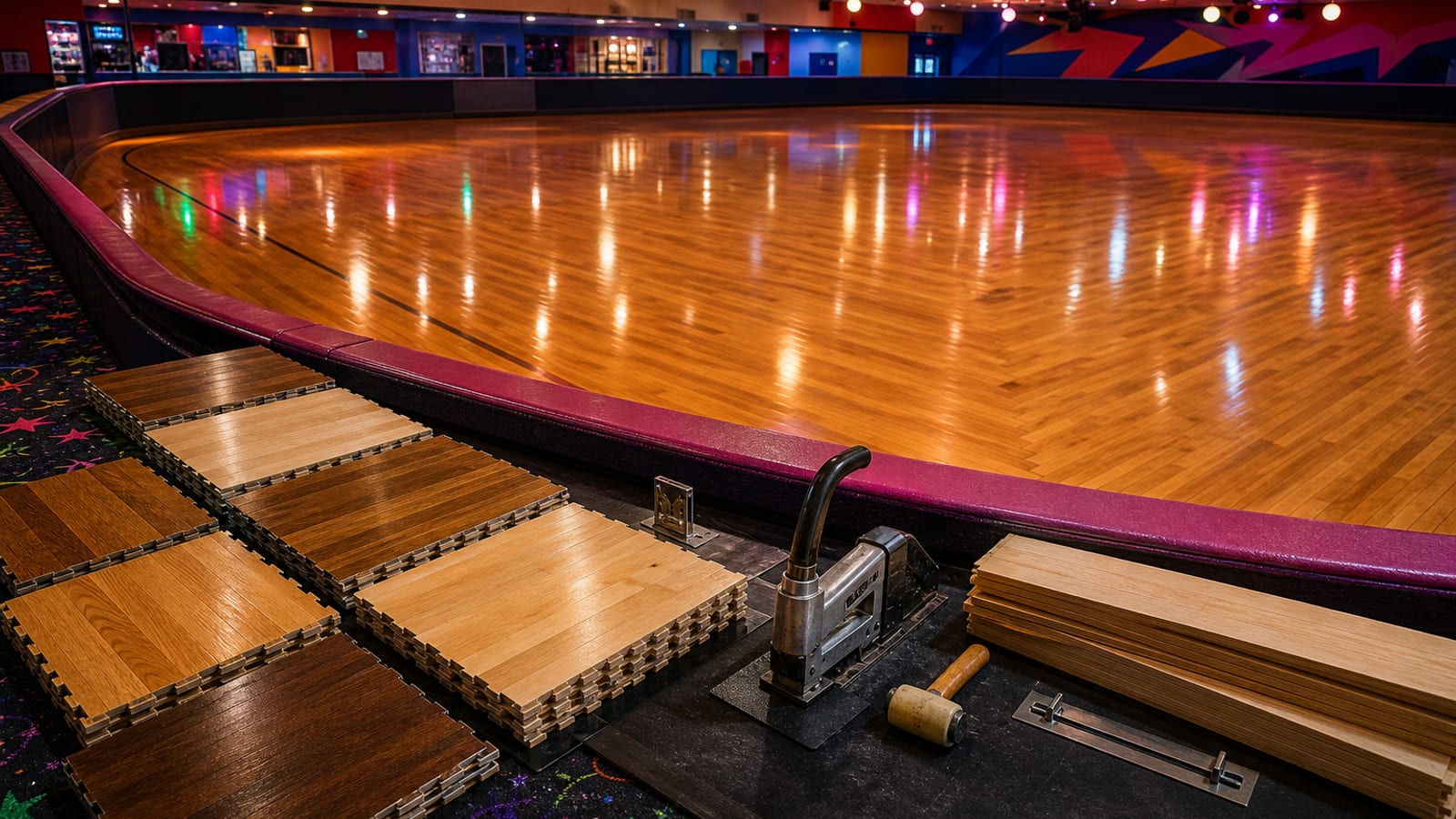
Whichever surface is chosen, the subfloor sequence is similar: clear and level the slab, install a moisture barrier, lay a smooth underlayment, and then bond or float the finish surface. Installation works best in dry, moderate conditions so adhesives cure properly and panels don’t move.
Floor installation typically runs 3–8 weeks depending on system and crew size.
Phase 4: MEP, Lighting, and Sound
A skating rink is essentially an assembly occupancy with high ventilation needs, dimmable house and effects lighting, and a sound system tuned to fill a large open volume. Combined lighting and sound packages have been reported in a wide range — roughly $95K to $700K — depending on whether the venue is positioned as a community rink or a high-production entertainment space with LED walls, lasers, and DJ booth.
This phase usually overlaps with floor installation and finishes, adding 4–8 weeks of dedicated MEP and AV work.
Phase 5: Front of House and Fit-Out
The remaining buildout includes reception and point-of-sale, skate rental counter, lockers, party rooms, concessions, restrooms, staff areas, and parking. Renovation and fit-out commonly absorbs 20–30% of total project investment, and a paved parking lot alone has been reported around $125,000, with exterior signage around $10,000.
Skate rental inventory is a separate capital line: rental skates run roughly $75–$250 per pair, and helmets $30–$150 each, before considering inline skates, skate aids, and protective gear for younger guests.
Fit-out and final inspections typically take 6–12 weeks.
Typical Overall Timeline
Combining the phases, a ground-up rink commonly takes 9–18 months from broken ground to opening day, with another 2–6 months of pre-construction work before that. A renovation of a suitable existing building — for example, a former big-box store or a closed rink purchased through commercial listings — can compress that timeline considerably, often into 4–9 months of active construction.
For prospective owners scouting markets, see our skating rinks directory for active venues, or browse the Illinois roller rinks page for examples of how established rinks are sized and configured.
FAQ
How big does a roller skating rink need to be?
Industry guidance puts the typical skating surface at about 15,000 square feet, often laid out roughly 125′ × 125′. Total building footprints usually fall in the 15,000–30,000 sq ft range once support spaces are included. A backyard or training floor can be much smaller — minimums as low as 20′ × 20′ are noted in DIY guides.
Do you need maple flooring?
No. Northern hard maple is the traditional benchmark for its grip-and-glide balance, but synthetic sheet systems, sealed concrete, and modular plastic tiles are all used in commercial rinks. Cost differences across systems are significant — modular tile can come in under $50K for a 15,000 sq ft floor, while hardwood can exceed $300K.
Is it cheaper to renovate an existing rink?
Often yes. Industry coverage notes that closed rinks have listed at starting prices near $1.2 million, with some closing for less than half that, and that buying an existing building skips much of the shell construction phase. Renovation still typically consumes 20–30% of the total project budget.
Sources
- How Much Does it Cost to Build a Roller Skating Rink? – ROLLER — square footage targets, floor material cost table, lighting and sound ranges, skate and helmet pricing
- How much does a roller rink cost? – RollerSk8r — $2–5M new-build range, $12–18M FEC range, metal building shell cost, parking and signage figures, floor cost range
- How to Build a Roller Skating Rink Floor in 5 Steps – Cora — floor build sequence, subfloor prep, moisture barrier, maple as benchmark material
- Future Rink Owner – Roller Skating Association — RSA Industry Guide scope and operator support resources
- Roller Skating Association – About — RSA founding year and role as the industry trade association