Roller Skating Rink Builders & Contractors
How roller skating rink builders approach site selection, flooring, layout, and budgeting — with verified cost ranges and vendor categories.
USA Skating Rinks Editorial Team
Updated May 29, 2026 · Editorial policy
In this guide
Scroll tables sideways to see all columns.
Building a commercial roller skating rink is a specialized construction project that combines sports flooring, entertainment design, and food-service buildout. Unlike ice rinks, roller rinks do not need refrigeration plants, but they demand a precise, level skating surface and a layout that supports concessions, party rooms, and rentals. This guide explains how the work is typically scoped, who is involved, and the cost ranges published by industry vendors.
What a Roller Rink “Builder” Actually Means
There is no single licensing category for “roller skating rink builder.” Most projects are delivered by a general contractor working alongside specialist subcontractors, particularly a sports-flooring installer. Common roles on a build team include:
- A general contractor handling shell construction, mechanicals, and fitout
- A sports-flooring vendor (maple, polyurethane, vinyl, or modular tile)
- An audio-visual integrator for the sound and lighting package
- A foodservice contractor for the snack bar and kitchen
- An architect familiar with assembly-occupancy codes
Some firms position themselves as turnkey skating-rink consultants. The Roller Skating Association International (RSA), the trade association for the industry since 1937, connects rink owners with manufacturers, suppliers, and consultants through its convention, trade show, and member directory.
Site Selection and Building Size
Industry guidance from ROLLER (rink management software) recommends a facility of at least 17,000 square feet to fit the skating floor, lobby, rentals, concessions, party rooms, restrooms, and back-of-house. A more conservative planning range for a commercial venue is 15,000 to 30,000 square feet. The skating surface itself is usually the largest single element of the floorplan.
Builders generally look for clear-span buildings with high ceilings (for sound, lighting trusses, and ventilation), adequate parking, and zoning that allows assembly use. Renovating an existing big-box or warehouse shell is often less expensive than ground-up construction.
Flooring: The Most Important Decision
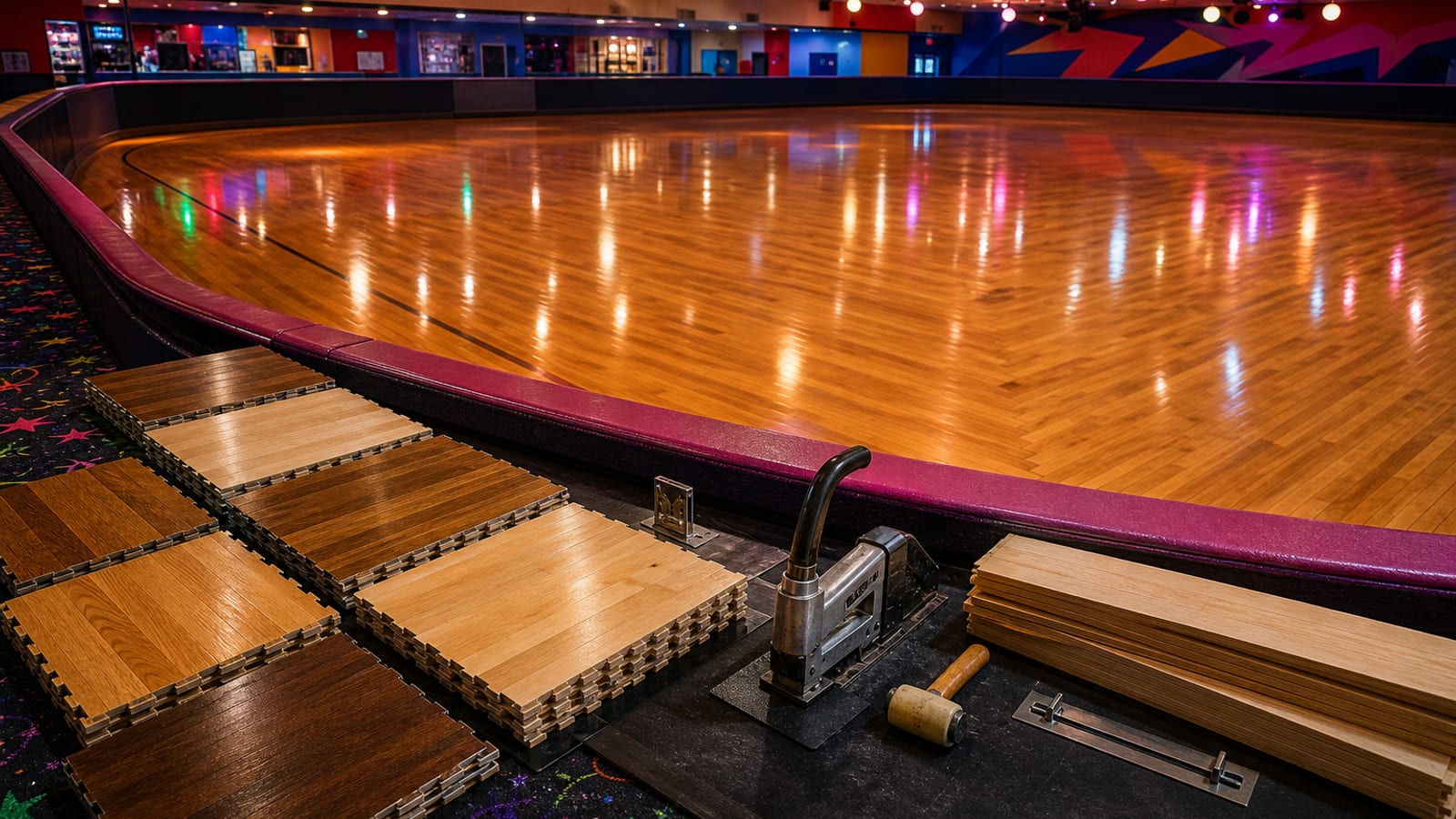
The skating surface defines the rink’s feel and long-term maintenance cost. Published vendor pricing varies by material:
| Floor type | Typical price per sq ft | Reported lifespan |
|---|---|---|
| Maple hardwood | $6–$10 | 20–25 years |
| Polyurethane (poured) | $4–$8 | 15–20 years |
| Vinyl | $3–$7 | 10–15 years |
| Rubber | $2–$5 | 8–12 years |
(Pricing reported by J & J Gym Floors, which specializes in roller rink surfaces in the Northeast, Mid-Atlantic, and Southeast.)
ROLLER’s cost guide reports total installed flooring budgets in the same direction: roughly $150,000–$315,000 for hardwood, $90,000–$255,000 for synthetic, and $15,000–$45,000 for modular tile systems. Modular sport-court systems from vendors like ZSFloor Tech and ModuCourts are the lowest-capex option and can be installed over an existing concrete slab.
Hardwood floors typically need sanding and refinishing every five to seven years according to flooring specialists, which should be factored into the operating budget.
Budget Ranges for a Full Project
ROLLER’s published cost analysis puts total startup investment for a new commercial roller rink at $500,000 to $1.5 million, with major line items including:
- Property purchase: $400,000–$3,000,000 (or lease at $50,000–$250,000 per year)
- Renovation and fitout: $350,000–$3,000,000
- Lighting and sound: $95,000–$700,000
- Rental skates: $75–$250 per pair
- Helmets and protective equipment: $30–$150 per helmet
A larger family entertainment center build (with arcades, laser tag, or bowling alongside the rink) can run substantially higher. Optum Construction Group, for example, documented a 20,000 sq ft FEC project that included an approximately 9,000 sq ft indoor roller floor along with arcade, indoor play area, and concession space.
Working with the Right Contractors
Because few general contractors have built a roller rink before, owners often de-risk the project by:
- Engaging the sports-flooring vendor early so the slab tolerances, moisture barriers, and substrate prep meet the manufacturer’s spec
- Joining the Roller Skating Association International ($450 annual dues at time of publication) for access to vetted suppliers and member discounts
- Visiting recently built rinks to evaluate floor feel, sightlines, and sound coverage
- Bidding the sound and lighting package separately from general construction, since AV integrators often deliver better results than a GC’s electrical sub
- Confirming local code requirements early — assembly occupancy triggers fire-suppression, egress, and ADA requirements that drive cost
For owners researching local market conditions, the skating rinks directory lists active venues by state, and the Illinois roller rinks page shows examples of the format and scale that work in the Midwest.
Timeline Expectations
Sports-flooring installers report that the surface itself takes anywhere from a few days to a couple of weeks to install depending on material and area. The full build — shell, fitout, MEP, flooring, AV, and inspections — typically takes several months for a renovation and substantially longer for ground-up construction. Permitting and inspection schedules vary widely by jurisdiction.
FAQ
Do roller rink builders also handle ice rinks?
Some do, but the skill sets diverge. Ice rink contractors (Rink-Tec International, Ice Builders, Rocky Rinks, MacLaughlin Management & Design) specialize in refrigeration plants and dasher boards. Roller rink projects rarely need that expertise; they lean more on sports flooring and entertainment-venue fitout.
Can a concrete slab be used as a skating surface?
Yes — sealed concrete is used in some rinks and is one of the lower-cost options per ROLLER’s published ranges. However, hardwood and poured polyurethane are generally preferred for traditional roller skating because they give a more forgiving roll and feel.
Is there a trade association that vets builders?
The Roller Skating Association International is the long-standing trade body for the industry. It does not “certify” builders, but its supplier membership, trade show, and member directory are the most direct way to identify vendors with actual roller-rink project experience.
Sources
- ROLLER — How Much Does it Cost to Build a Roller Skating Rink? — total budget ranges, flooring totals, lighting and equipment line items
- ROLLER — How To Open a Roller Skating Rink — minimum facility size (17,000 sq ft), planning steps, permitting
- J & J Gym Floors — Roller Rink Floors — per-square-foot pricing and lifespan for maple, polyurethane, vinyl, rubber; refinishing cadence
- Roller Skating Association International — trade association role, membership dues, supplier connections
- Optum Construction Group — Great Skate Project — example FEC project with ~9,000 sq ft roller floor inside a 20,000 sq ft facility
- Sports Venue Calculator — Ice Rink Construction Companies — identification of ice-rink specialist contractors referenced for contrast