Ice Skating Rink Construction: Process & Vendors
How ice skating rinks are built — from refrigeration slabs and dasher boards to backyard kits — with real cost ranges and vetted vendors.
USA Skating Rinks Editorial Team
Updated May 29, 2026 · Editorial policy
In this guide
Scroll tables sideways to see all columns.
Ice skating rink construction spans an enormous range, from a few hundred dollars of plastic liner and lumber in a backyard to multi-million-dollar twin-sheet arenas with industrial refrigeration plants. The fundamentals, however, are similar at every scale: a flat, well-prepared surface; a way to keep water frozen; a perimeter that contains skaters and pucks; and a buildup of thin ice layers rather than one deep pour. This guide walks through the construction process, typical costs, and the most commonly cited vendors in the North American market.
Standard Rink Dimensions
The NHL ice surface is 200 feet long by 85 feet wide with 28-foot corner radii, while an Olympic / IIHF sheet measures roughly 200 by 98 feet. A full hockey sheet covers about 17,000 square feet of ice. Public skating rinks vary widely, from compact 1,200-square-foot surfaces in malls and seasonal pop-ups up to full hockey dimensions.
| Rink type | Surface area |
|---|---|
| NHL hockey (200’ × 85’) | ~17,000 sq ft |
| Olympic / IIHF (200’ × 98’) | ~19,600 sq ft |
| Curling sheet | ~2,250 sq ft |
| Public / recreational | 1,200 – 17,000 sq ft |
Site Preparation and the Concrete Slab
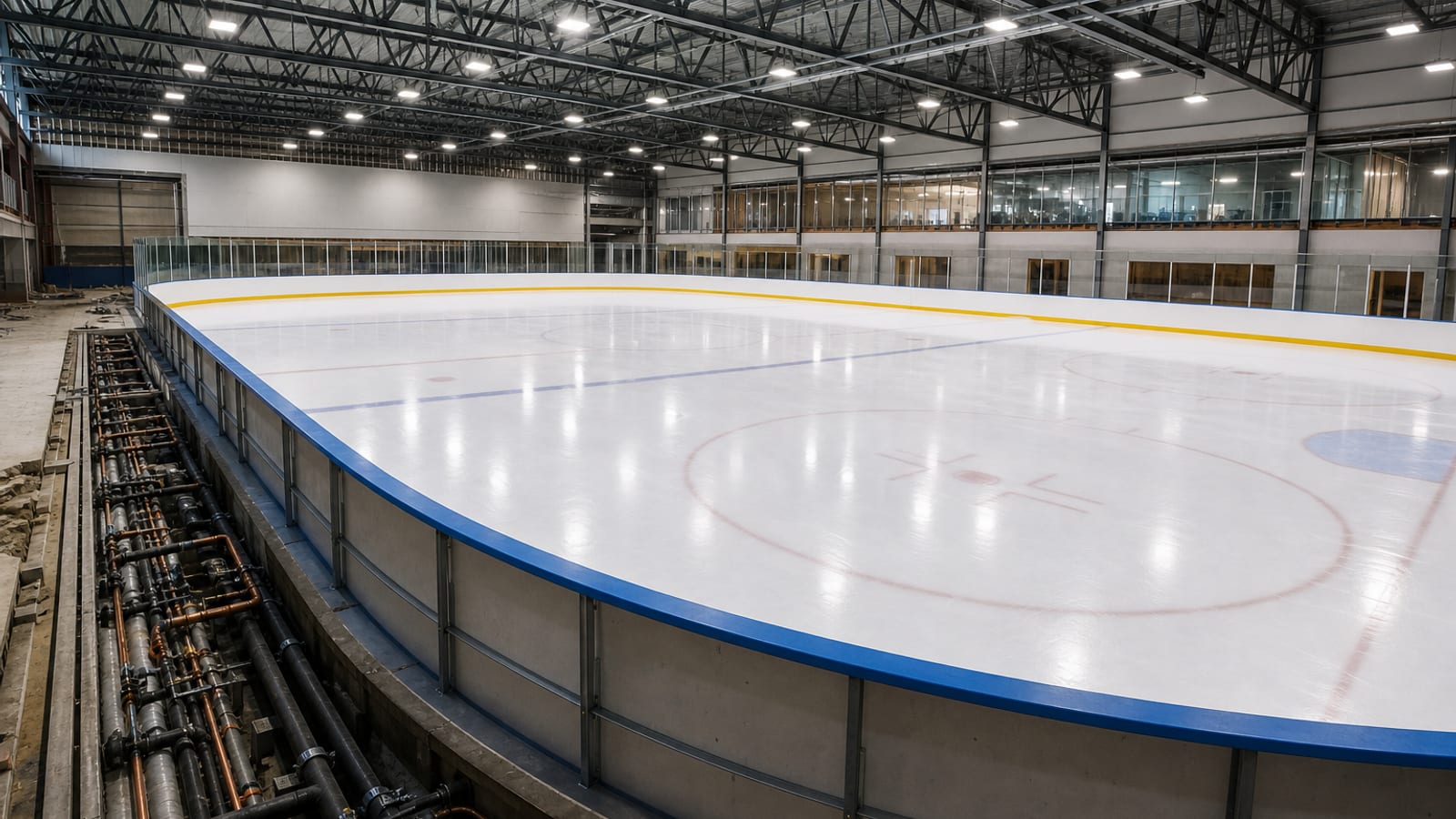
Permanent indoor rinks are built on a reinforced concrete pad — commonly 5 to 6 inches thick with rebar — that doubles as the refrigeration floor. Embedded in that slab is a grid of cooling pipes, typically 1-inch polyethylene or steel tubing spaced on 3- to 4-inch centers, fed by 6- to 10-inch PVC or steel headers around the perimeter. Site work also has to address subgrade insulation and, in many climates, a heated under-slab loop to prevent frost heave beneath the cold floor.
The Refrigeration Plant
The refrigeration system is the single biggest mechanical investment in a permanent rink. A chiller cools a secondary heat-transfer fluid — usually a calcium chloride brine mixed to a freeze point of roughly −5 °F to −10 °F, or a glycol solution — which is then pumped through the floor grid to draw heat out of the slab.
Refrigeration loads scale with surface area and building envelope. A full-size hockey arena typically requires somewhere in the range of 45 to 300 tons of refrigeration, depending on insulation, climate, and how aggressively the ice must be cooled. According to cost references compiled by Sports Venue Calculator, refrigeration system equipment alone can run from about $3,000 on the smallest scale up to roughly $60,000 for typical small commercial systems, with full industrial plants serving NHL-grade rinks costing dramatically more.
Building Up the Ice
Real ice is never poured in one go. Once the slab is chilled below freezing, water is applied in extremely thin layers — roughly 1/16 to 1/8 inch at a time — letting each layer freeze before the next is sprayed on. The first layers are kept clear, then the surface is painted white, lines and faceoff circles are painted on (often using pre-cut fabric logos), and additional clear layers are flooded over the markings to lock them in. The finished sheet on a professional rink is about 0.75 to 1.5 inches thick.
A typical construction sequence:
- Pour and cure the insulated, piped concrete slab.
- Install dasher boards, glass, and player benches around the perimeter.
- Charge the refrigeration system and pull slab temperature down.
- Flood thin clear layers until a sealed base forms.
- Paint the white base coat, then lines, circles, and logos.
- Flood additional clear layers up to playing thickness.
- Resurface with an ice-resurfacing machine (Zamboni-style) to finish.
What It Costs to Build
Construction costs depend on whether the rink is real ice or synthetic, indoor or outdoor, and how much supporting infrastructure (locker rooms, seating, concessions) is included.
- Small indoor real-ice rink: roughly $150,000 to $950,000 in equipment and rink components, per Sports Venue Calculator.
- Outdoor seasonal rink: generally falls in the lower end of that range, with much of the cost in boards, liner, and a smaller refrigeration package.
- Twin-sheet community arena: The Sports Facilities Companies estimates roughly $37.6M to $46M, or about $398 to $486 per square foot, for a two-sheet facility — excluding land.
- Synthetic ice installations: $14,000 to $395,000 depending on panel quality and size, with no refrigeration required.
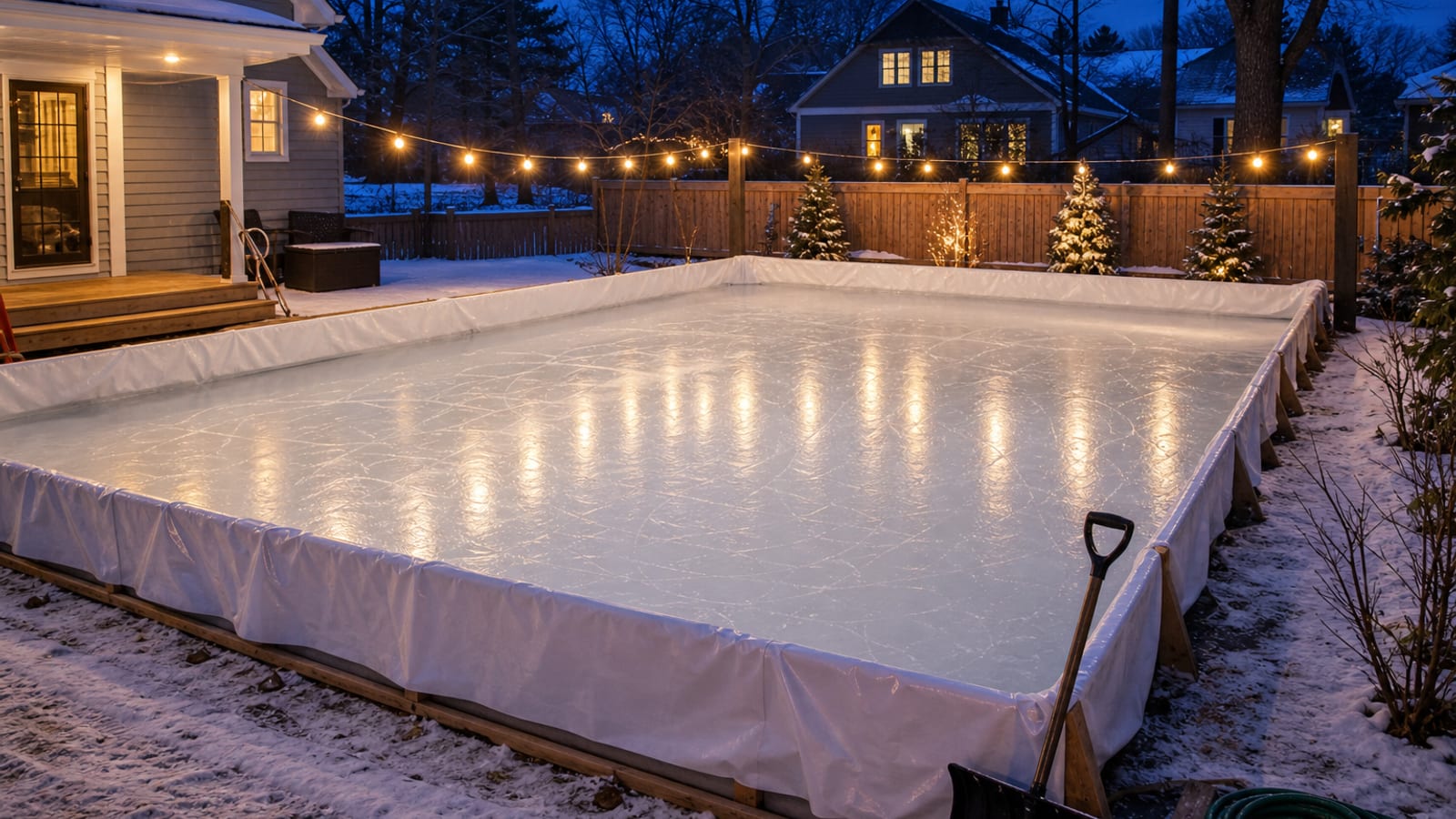
- Backyard kits: Iron Sleek’s DIY backyard rink kits list from about $219.99 for a 20’×20’ setup up to roughly $3,017 for a 90’×200’ configuration, with the lumber sideboards purchased separately.
Equipment line items add up quickly: ice-resurfacing machines alone range from about $10,000 for a used compact unit up to $250,000 for a new full-size electric Zamboni-class machine.
Vendors and Manufacturers
A handful of established suppliers cover most of the North American market:
- Iron Sleek — Steel bracket systems and complete backyard kits in more than 50 sizes from 20’×20’ to 90’×200’.
- NiceRink — Patented bracket system designed to accommodate uneven ground, sold with UV-stabilized white liners.
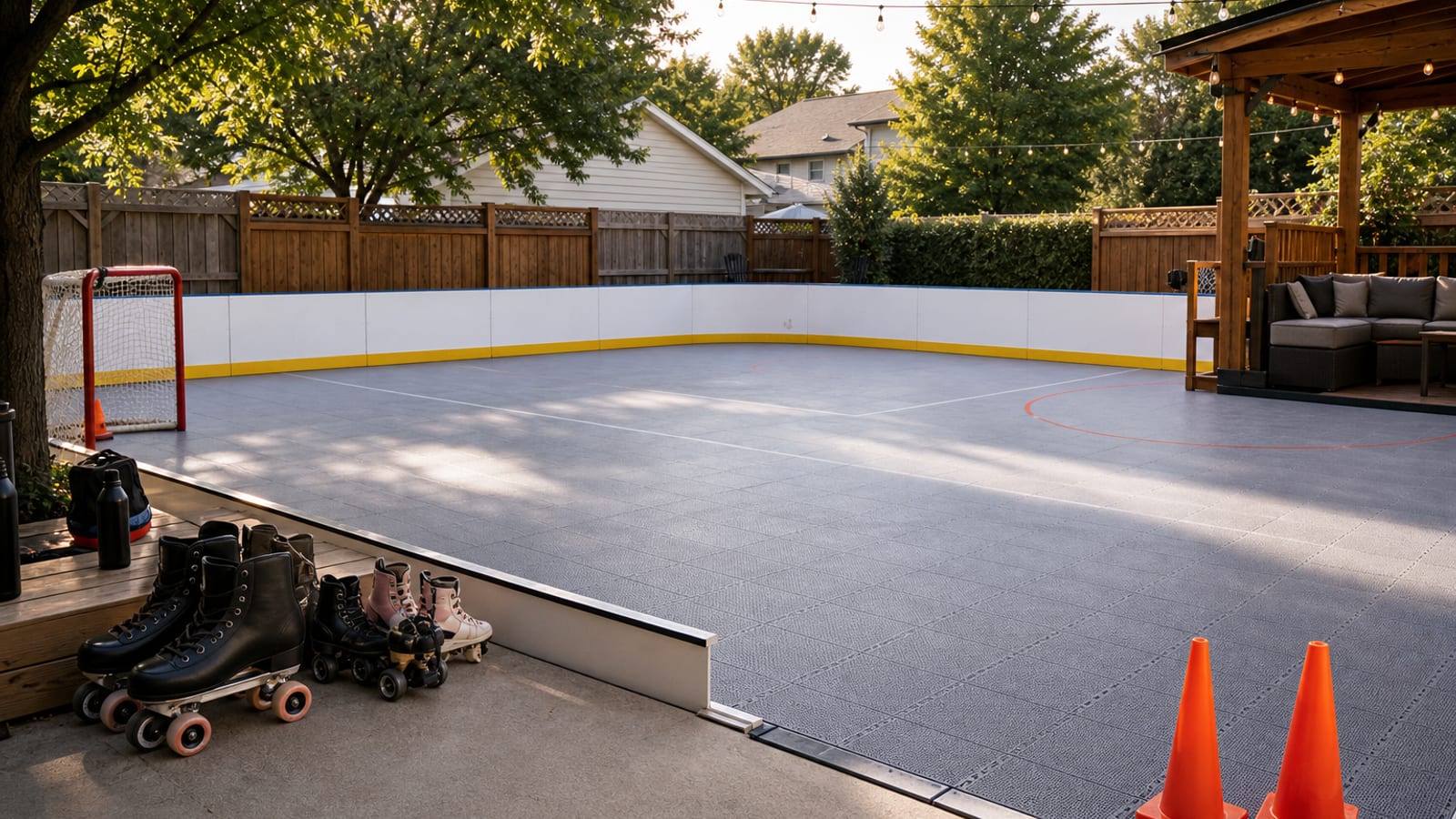
- Glice and Xtraice — Manufacturers of synthetic (self-lubricating polymer) ice panels used for year-round installations where refrigeration isn’t viable.
- Rocky Rinks and similar mechanical contractors — Design and install chillers, headers, and floor piping for commercial rinks.
- Sports Facilities Companies / Firland Management — Pre-development and operations consultants for community ice complexes.
When evaluating a vendor, the most useful documents to request are a refrigeration heat-load calculation, slab and piping specifications, a dasher-board package list, and a written operations and maintenance plan.
Related Reading
Looking for places to skate rather than build? Browse the skating rinks directory for facilities by state, or jump straight to listings in Ohio roller rinks for nearby family-friendly venues.
FAQ
How long does it take to build an ice rink?
A backyard kit can be installed in an afternoon and frozen in a few cold nights. A permanent indoor rink, including refrigeration, dasher boards, and the building shell, is typically a multi-month construction project, with twin-sheet community arenas often planned over 12 to 24 months from design through opening.
How thick is the ice on a professional rink?
Professional ice sheets are generally built up to about 0.75 to 1.5 inches thick using many thin flooded layers, with painted lines and logos sealed between clear coats.
Do you need refrigeration for every rink?
No. Synthetic ice rinks from manufacturers such as Glice and Xtraice use self-lubricating polymer panels that skate without any cooling system, which is why their installation cost range starts far below that of a real-ice build.
Sources
- Cost to Build an Ice Rink for Permanent Use — Sports Venue Calculator — Equipment cost ranges for refrigeration, resurfacers, real vs synthetic rinks, and rink dimensions.
- Breaking the Ice: How Much Does it Cost to Build an Ice Rink? — Sports Facilities Companies — Twin-sheet arena cost estimate of $37.6M–$46M and $398–$486 per square foot.
- Backyard Ice Rink Kits — Iron Sleek — Kit pricing from $219.99 to $3,017, available sizes, and steel bracket construction details.
- How are Hockey Rinks Made? — PolyGlide Ice — Thin-layer flooding process (1/16 to 1/8 inch), line painting sequence, and 1 to 1.5 inch finished thickness.
- Hockey Rink Dimensions — Sports Feel Good Stories — NHL 200’×85’ dimensions with 28’ corner radius.
- Ice Rink Refrigeration System Guide — Rocky Rinks — Chiller types, header configurations, and design considerations for refrigeration piping.