How to Build a Backyard Roller Skating Rink
A practical guide to planning, surfacing, and building a backyard roller skating rink — from site prep and concrete specs to modular tile options.
USA Skating Rinks Editorial Team
Updated May 29, 2026 · Editorial policy
In this guide
Scroll tables sideways to see all columns.
A backyard roller skating rink can be as simple as a smooth concrete slab the size of a small driveway, or as polished as a modular tile court engineered for quad and inline skating. The right approach depends on your space, your budget, and how much skating the surface needs to absorb. This guide walks through the realistic planning, surface, and installation decisions, drawing on specifications published by court-tile manufacturers and outdoor flooring guides.
Plan the Footprint First
The most common piece of advice across DIY guides is to start with the footprint and work backward. A minimum of roughly 20 by 30 feet is a common recommendation for casual skating, with anything larger allowing wider turns and basic hockey or derby drills. Before committing to a size, check the slope of the area; outdoor sport-tile manufacturer VersaCourt recommends a finished base slope between 0.5% minimum and 1% maximum to drain water without affecting skating.
Also confirm:
- Setbacks from fences, trees, and property lines per local zoning
- Whether your municipality requires a permit for a permanent slab
- Drainage paths so water sheds away from the house
If you are still researching local options before committing to a build, the skating rinks directory lists public and private rinks across the country.
Choose a Surface
There are three realistic surface categories for a backyard roller skating rink: poured concrete, asphalt, and modular sport tiles installed over an existing hard base.
| Surface | Best For | Notes |
|---|---|---|
| Concrete slab | Permanent, smoothest glide | Higher upfront cost; needs proper joints and finish |
| Asphalt | Lower cost, larger areas | More prone to cracking in freeze-thaw climates |
| Modular tiles | Retrofitting existing slabs | Easiest DIY; performance designed for skate wheels |
For an indoor space, see our garage and basement roller rink guide. Compare removable surface systems in the portable skating rink floor guide, or read about roller rink floor types and maintenance before choosing a surface.
Pace Court’s outdoor skating flooring guide notes that concrete and asphalt are cost-effective long-term solutions and are compatible with synthetic acrylic coatings that add UV protection and traction. Modular interlocking tiles are highlighted as a quick-install alternative with built-in drainage.
Concrete Base Specifications
If you are pouring a slab — either as the finished skating surface or as a base for tiles — VersaCourt’s published subsurface specifications are a good benchmark:
- Minimum 4-inch thickness for typical joint spacing (3.5” works for 6-foot joint spacing; 5” for 12-foot spacing)
- 3,000 PSI concrete strength at 28 days
- Medium broom finish
- 6x6 W1.4xW1.4 welded wire fabric or #5 rebar at the perimeter
- Minimum 6 inches of compacted subgrade at 98% maximum density
- Expansion joints sealed with an oil- and fuel-resistant sealant
For skating directly on concrete, a tighter steel-trowel finish glides better than a broom finish, but a steel-troweled surface can be slick when wet. Many backyard builders compromise with a light broom finish and a clear acrylic sealer.
Modular Tiles Over an Existing Surface
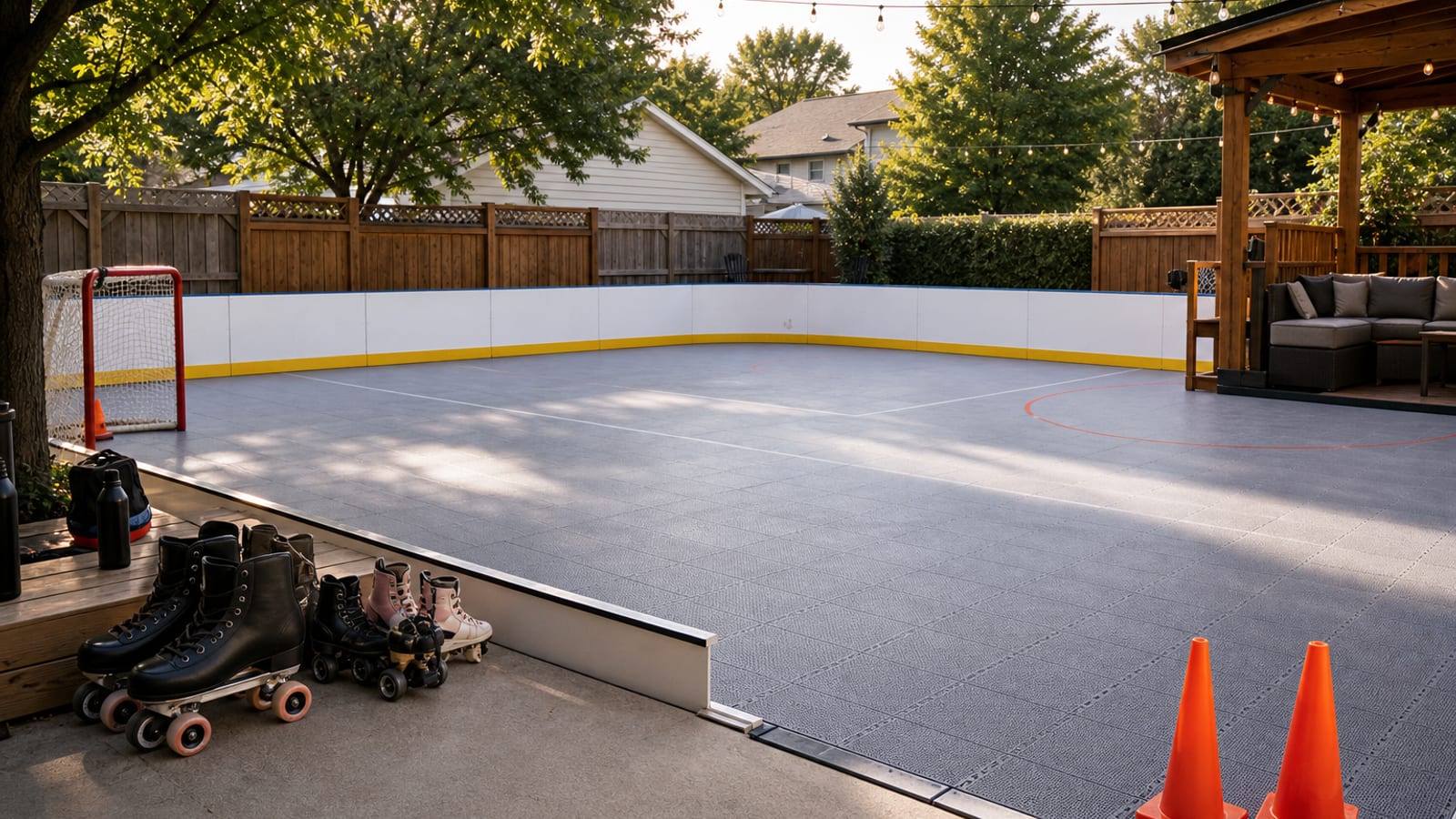
Modular tiles are the most accessible option for homeowners who already have a patio, sport pad, or driveway extension. VersaCourt’s Compete skate tile uses a two-level surface design molded from high-impact copolymer polypropylene, with perforations that drain water and a suspended structure intended to reduce joint stress. Sport Court markets a similar line for roller sports and inline hockey.
For indoor garage rinks, Flooring Inc.’s HotShot Hockey Tiles are 18-inch by 18-inch polypropylene tiles designed to install over any hard, flat, clean, dry surface — concrete, asphalt, or wood subfloor — with a 3/4-inch expansion gap around the perimeter. The manufacturer explicitly rates them indoor-only, so for outdoor use you should choose a tile system rated for UV and freeze-thaw exposure.
Step-by-Step Build Sequence
- Mark and excavate. Stake the footprint, strip vegetation and topsoil, and excavate to allow for the subgrade and slab.
- Compact the subgrade. Use a rented plate compactor to reach a firm, even base. Sport-tile manufacturers commonly call for 98% compaction.
- Set forms and reinforcement. Install wooden forms to the planned slope (0.5–1% per VersaCourt) and lay welded wire fabric or rebar.
- Pour and finish concrete. Pour to the specified thickness, screed, float, and finish. Add tooled control joints to prevent random cracking.
- Cure. Keep the slab damp for several days; concrete reaches design strength at 28 days.
- Apply coating or install tiles. Either roll on an acrylic sport coating or click together modular skate tiles per the manufacturer’s instructions.
- Add edges and accessories. Boards, low rails, or perimeter edging tiles finish the rink and keep skates from rolling onto turf.
Lighting, Drainage, and Accessories
Outdoor skating after dusk needs reasonable lighting. LED flood fixtures on existing structures or freestanding poles are the simplest path. Plan drainage so rain runs off the long axis of the slab and away from the house. A garden hose or leaf blower is enough to clean perforated tile surfaces, according to VersaCourt’s maintenance notes.
If the rink will host hockey or derby practice, consider low boards or netting at the ends. For a quieter neighborhood-friendly rink, skip boards and use a soft perimeter buffer of turf.
Climate and Long-Term Maintenance
Asphalt is the most weather-sensitive option; VersaCourt notes that asphalt “is more susceptible to cracks and fractures and will eventually deteriorate with repeated freeze-thaw cycles.” In colder regions, concrete with proper joints is more durable. Pace Court recommends periodic crack repair and recoating every few years to keep outdoor surfaces safe and smooth.
Skaters in the Midwest comparing backyard builds to nearby public rinks can browse the Ohio roller rinks listings for indoor alternatives during winter months.
FAQ
What is the smallest practical size for a backyard roller skating rink?
DIY guides commonly recommend a minimum of about 20 by 30 feet for casual skating. Smaller pads work for practicing footwork, but they limit turning radius and speed work.
Is concrete or asphalt better for a backyard rink?
Concrete provides a smoother, more durable skating surface and tolerates freeze-thaw cycles better when properly jointed. Asphalt is typically cheaper to install but more prone to cracking over time, according to VersaCourt’s subsurface guidance.
Can I install skating tiles directly over grass or dirt?
No. Modular skating tiles from manufacturers like VersaCourt, Sport Court, and Flooring Inc. require a hard, flat, stable base — typically concrete or asphalt — to perform safely and lock together correctly.
Sources
- VersaCourt Subsurface Preparation — concrete thickness, slope, PSI, joint spacing, and asphalt freeze-thaw notes
- VersaCourt Skating Rink Flooring — Compete two-level skate tile design, polypropylene material, drainage perforations, maintenance
- Pace Court Outdoor Skating Rink Flooring Guide — surface category comparison, coatings, drainage, and recoating cadence
- Flooring Inc. HotShot Hockey Floor Tiles — 18x18 tile size, polypropylene construction, indoor-only rating, 3/4-inch expansion gap
- Sport Court Roller Sports & Hockey Surfaces — modular tile suitability for inline skating, roller derby, and outdoor hockey